
Revisiting Tunica Mound and Jeanerette Hill with Qimera

Following on from our earlier look at VK 906 , graduate student Lexie DelViscio has been working on a new multibeam surface. This one covers the area around Tunica Mound and Jeanerette Hill in the northern Gulf of Mexico. The data come from NOAA Ship Okeanos Explorer mission EX1402 Leg 2, collected in spring 2014 and freely available through NCEI.

My workflow in QPS Qimera was similar to that of VK 906, with a few changes:

  • SVP correction with XBTs. I sound-velocity corrected the lines using the XBT casts collected during the cruise.
  • TU Delft Sound Speed Inversion. This is a Qimera tool developed with Delft University of Technology. It uses the overlap between neighboring survey lines to estimate sound speed corrections that best line up the overlapping swaths. This reduces the refraction “smiles” and “frowns” in the outer beams that sparse or mistimed sound speed profiles can leave behind.
  • 3D Editor cleaning. I removed spikes and other poor-quality soundings in the 3D Editor alongside the slice editor.
  • Gridding. The final surface is a CUBE grid at 20 m resolution.

Mapping in ArcGIS Pro

I exported the surface from Qimera as a single-band ESRI ASCII grid. In ArcGIS Pro, I set the empty cells (stored as 0) to NoData and defined the coordinate system (WGS 1984 UTM Zone 15N). I then draped the depths over a hillshade with 3× vertical exaggeration so the relief stands out. Some artefacts are still visible, mainly along-track striping / nadir artefacts at line edges. 
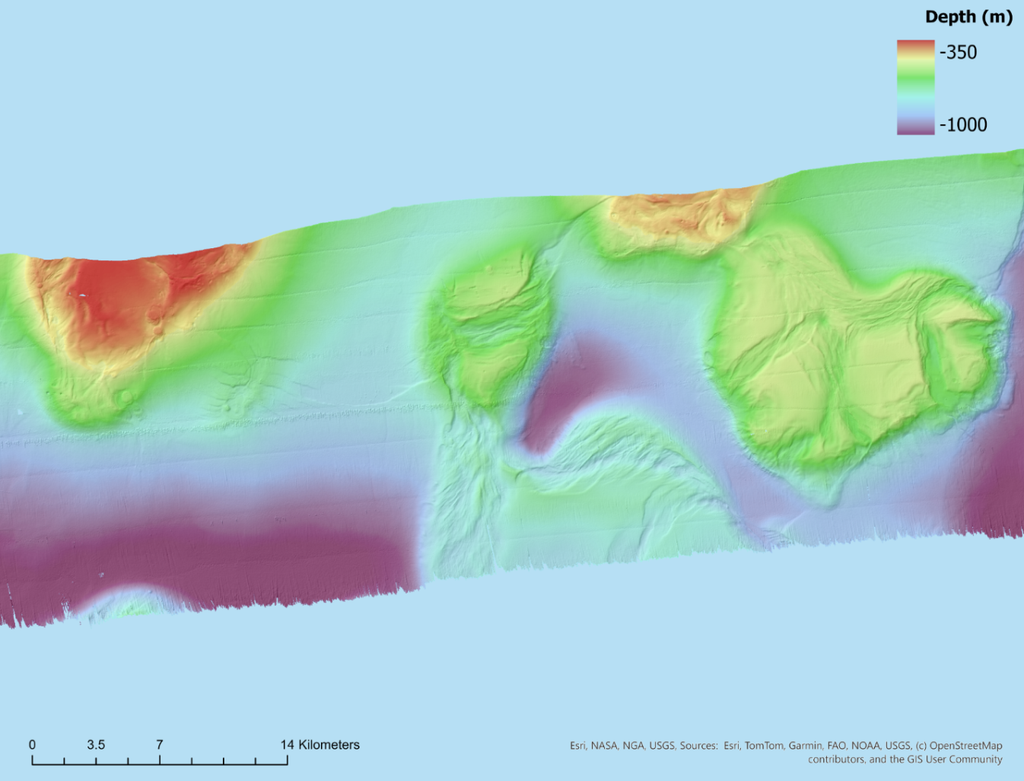
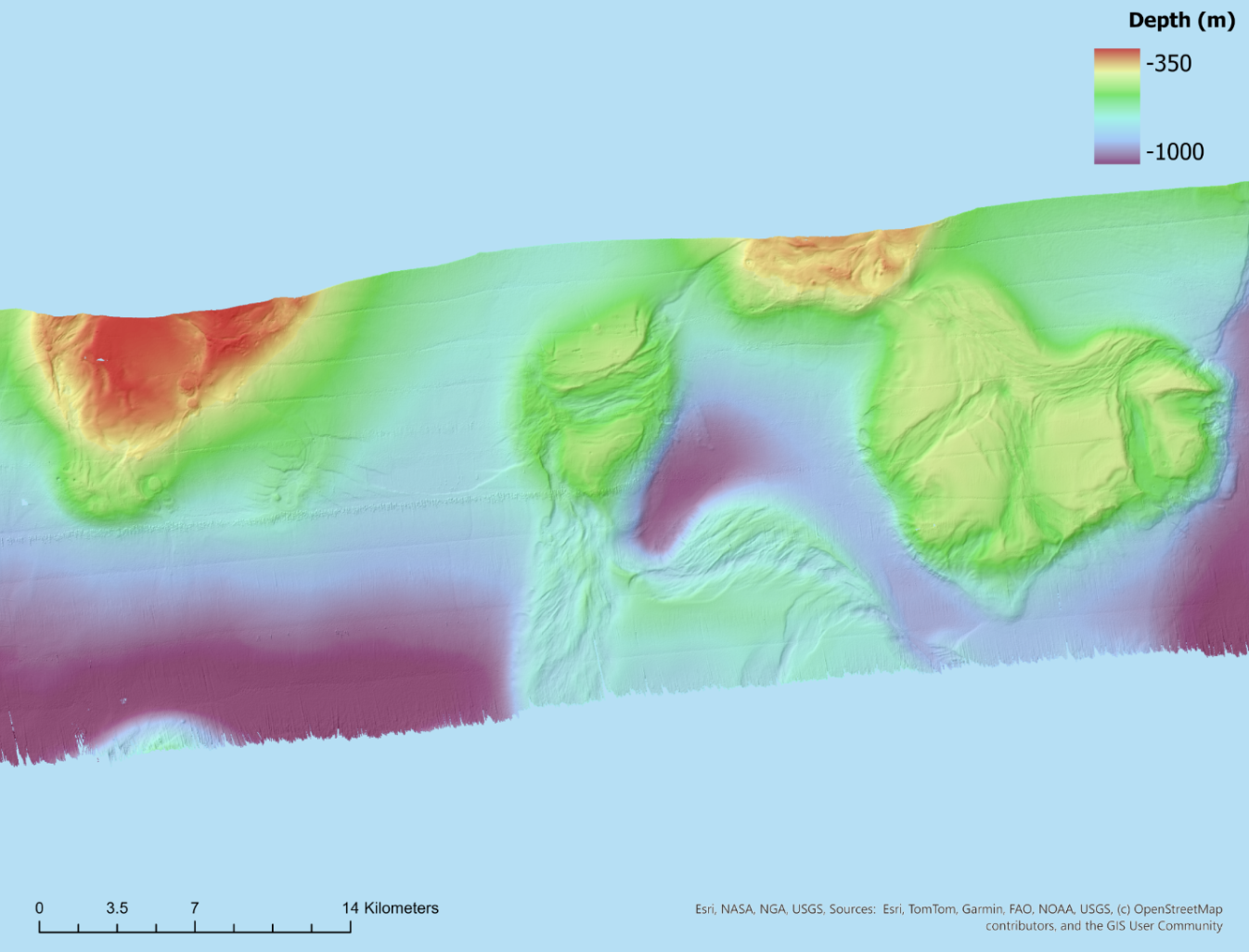
Figure: Multibeam bathymetry of Jeanerette Hill and Tunica Mound from NOAA Ship Okeanos Explorer EX1402 Leg 2 (EM302, 2014; NOAA Ocean Exploration / NCEI). Processed in QPS Qimera (CUBE, 20 m) and mapped in ArcGIS Pro by L. DelViscio. Depths shown over a hillshade with 3× vertical exaggeration.

Qimera was provided by QPS.

New Ascophyllum paper

Sex-specific reproductive trade-offs in the gregarious fucoid macroalga Ascophyllum nodosum

Kurr M, Davies AJ

The existence of sex-specific reproductive trade-offs is well established in plants. They usually occur because females invest more resources into reproduction than males, and have to compensate by sacrificing growth or defence. Investigations into by-sex differences in resource allocation by seaweeds are comparatively scarce. A small number of authors report differences between the sexes in some red algae, but known by-sex differences in brown algae are largely confined to the reproductive structures. In this study, sex-specific reproductive trade-offs are investigated in the common temperate brown alga Ascophyllum nodosum from three distinct populations. Quantified investments into growth, defence, and reproduction of a large number of individuals (n = 720) selected across a full annual cycle are presented in parallel with feeding trials using a common gastropod herbivore and a comprehensive assessment of the biotic and abiotic stressors impacting on A. nodosum at three sites. These reveal that sex-specific reproductive trade-offs occur in two of the three populations, as females invest more into reproduction than males and are subsequently less chemically defended for the months post gamete release. Feeding trials confirm that this leaves females more vulnerable to grazing pressure during these months, although mortality and competitive ability appear unaffected in the field. Possible causes of the trade-offs made by females are discussed, and new avenues of investigation are identified which could reveal interesting parallels between seaweeds and higher plants.

Full Citation

Kurr M, Davies AJ (2017) Sex-specific reproductive trade-offs in the gregarious fucoid macroalga Ascophyllum nodosum, European Journal of Phycology, DOI: 10.1080/09670262.2017.1328746

Link

http://www.tandfonline.com/doi/full/10.1080/09670262.2017.1328746

New paper in L&O

Tidal modulation of seabed light and its implications for benthic algae

Roberts EM, Bowers DG, Davies AJ

The temporal behavior of seabed light in a shallow, tidal sea is set largely by the interaction of the solar elevation cycle with tidal cycles in water depth and temporal variability in water clarity. The effect of tidal modulation on seabed light often does not simply average out, producing instead a net effect (either an amplification or a reduction of seabed light, integrated over time) compared to a tideless, but otherwise equivalent, scenario. Observations of this phenomenon from the Bay of Brest (France) show reasonable agreement with predictions based on an earlier theoretical framework, confirming that the key physics has been understood and that the important parameters are tidal amplitude, timing of low waters, diffuse attenuation coefficient, and daylength. Implications for benthic macroalgae living in the bay’s shallow subtidal zone are investigated using a simple numerical model. The effects of the tide on time-integrated seabed light and, in turn, time-integrated macroalgal community photosynthesis in the Bay of Brest correspond closely at three timescales: annual, springs-neaps (i.e., approximately fortnightly), and daily. Tidal amplification of both parameters occurs over the year, during winter months generally, and at spring tides during winter specifically (slight reduction occurs at neaps during winter). For an individual, isolated thallus, the relationship between tidal modulation of seabed light and photosynthesis is complicated by more pronounced light-saturation and photoinhibition effects. Demonstrated here for the first time, neglecting tidal effects on seabed light is likely to result in erroneous estimates (and, for many sites, underestimation) of subtidal benthic productivity.

Full Citation

Roberts EM, Bowers DG, Davies AJ (2017) Tidal modulation of seabed light and its implications for benthic algae. Limnology and Oceanography. doi:10.1002/lno.10616

Link

http://onlinelibrary.wiley.com/doi/10.1002/lno.10616/full